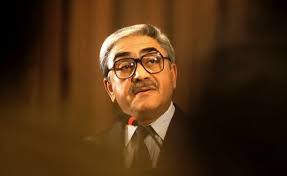
Ahmed Taleb Ibrahimi, the last great voice of revolutionary Algeria


[behinder]
Ahmed Taleb Ibrahimi died this Sunday, October 5 at the age of 93. A look back at the journey of the man who wanted to reconcile authenticity and universality
With Ahmed Taleb Ibrahimi, who died this Sunday, October 5 at the age of 93, undoubtedly disappears one of the last privileged witnesses of revolutionary Algeria and the adventures of its independence.
A man of state and spirit who left his mark on all the stages he went through and the positions he held.
A doctor by training, mujahid, man of culture, intellectual, several times minister, writer and committed activist, Ahmed Taleb Ibrahimi embodies a generation of Algerian executives whose flamboyance and lucidity of mind contrast curiously with certain political trajectories, often at odds with their convictions.
Despite the image of an open and cultured man, there was never complete consensus. Some criticise him for having been the ideologue of the Boumediene regime, to which he was very close, others for having become the godfather of the Arabisation of the – school whose limits we measure today –, still others to represent a “BCBG” Islamism, too religious for some, too modernist for others.
Ahmed Taleb Ibhrahmi, the man who wanted to reconcile authenticity and universality
He denied it though. “As for the homeland, all in all, I served it with passion and humility. I love his heroes and his sages. I love its nature and culture. And I cannot silence my last prayer: may the Algerian land shelter my grave”, he wrote in his memoirs.
Born in Sétif in 1932, Ahmed Taleb Ibrahimi grew up in the shadow of his father, Cheikh Bachir El Ibrahimi, a major figure in Muslim reformism who succeeded Abdelhamid ben Badis at the head of the Association of Algerian Ulemas.
It is therefore natural that his education is imbued with faith, rigor and commitment. A medical student in Paris in the mid-1950s, he founded the newspaper Le Jeune Musulman and became president of the General Union of Algerian Muslim Students (UGEMA), which he transformed into a political lever in the service of the national fight against colonialism French.
This activism led to his being arrested by the French authorities in 1957 and imprisoned in the Santé prison until March 1962, alongside figures like Hocine Aït Ahmed, Ahmed Ben Bella, Mohamed Khider, Mustapha Lacheraf and Mohamed Boudiaf.
“Of the five years spent in French prisons, we must add the eight months spent in the prison of the first president of independent Algeria”, he wrote later, with bitterness, on this period when he was tortured under the regime of President Ahmed Ben Bella, who had little respect for his father.
Unlike certain leaders of independent Algeria, Ahmed Taleb was a fervent defender of the Soummam Congress and Abane Ramdane, whose memory he endeavored to preserve with each attempt at demonisation.
Returning to the country after independence, he joined power and participated in the establishment of the young independent Algerian state. Minister of Education (1965-1970), then of Culture and Information (1970-1977), advisor to the president Boumediene then Chadli, then finally Minister of Foreign Affairs (1982-1988), he worked to reconcile authenticity and modernity, an exercise whose complexity and difficulty he admitted, in a period of profound changes in society which was emerging from a long night colonial.
At the Ministry of Education, he launched the major educational reform and pushed the Arabisation of the education system.
Convinced that the Arabic language constitutes the identity base of the country, he then wrote in a contribution to “Le Monde Diplomatique”: “Among the construction tasks which press us from all sides, the recovery and development of our cultural heritage does not is neither the least urgent nor the least important. But, to express this culture in all its authenticity, there can only be one instrument: the Arabic language. We can only recognise, with historians and linguists, that a people who change their language is a people who change their soul and their perspectives on the world.
The turning point
Deaf to criticism from progressive circles, Ahmed Taleb Ibrahimi nevertheless ended up recognising, years later, the error of this policy. He had the courage to admit that the exclusion of the Amazigh dimension was a historic mistake.
A confession he made on television sets. In 1988, he left the government, refusing to condone the repression of the October 5 demonstrations which shook Algeria the same year. This departure marks a turning point. From then on, he became the voice of an inclusive political dialogue, including with the dissolved party, the FIS.
“Exiting the crisis requires exclusively a political approach based on dialogue which does not exclude any party, not even the FIS”, he declared during the FLN congress in 1998, while the country was prey to violence terrorist born from the interruption of the electoral process in 1992.
A harsh judgment on Bouteflika
Candidate for the 1999 presidential election — from which he withdrew with Mouloud Hamrouche, Mokdad Sifi, Abdallah Djaballah, Aït Ahmed and Youcef El Khatib —, then initiator of the Wafa movement in 2002, of which the Minister of the Interior Yazid Zerhouni refused approval, he denounces the blocking of the political field and electoral manipulation.
Having known Abdelaziz Bouteflika as early as the 1960s, he had a harsh judgment on him: “It has escaped no one’s notice that Bouteflika is in reality only a seemingly president, betrayed by his lack of foresight and determination”.
Disillusioned, Ahmed Taleb gradually withdrew from active political life. His interventions will be rare, but always marked by deep lucidity.
In 2017, he called for President Bouteflika’s incapacity, then in 2019, on the eve of the presidential election, he called for dialogue by greeting the youth of Hirak: “She raised her voice without rejecting her values or her culture, remaining attached to his spiritual, civic and ethical heritage”, he said of this youth.
One of the rare Algerian politicians to have recorded his memoirs, Ahmed Taleb returns in the fourth volume of “Mémoires d’un Algérien”, published by Casbah Éditions, on many aspects which marked his career. He recounts the loneliness, the betrayals, his relations with the late president Chadli Bendjedid, Ali Kafi, Aït Ahmed, Abdelaziz Bouteflika and Hirak, among others. “I feel lonely… Ingratitude is commonplace and loneliness is the price of moral independence”.
Thus ends the journey of a man whose destiny will undoubtedly have been thwarted by the vagaries of history, but who remained faithful to his convictions, trying in vain to reconcile authenticity and modernity. A challenge that the country still faces…